Hand-Thrown or Moulded? Read the Marks on a Ceramic Bowl
Learn to read hand-thrown or moulded ceramic bowl marks, spot misleading clues, and decide what to inspect next without relying on a single feature.
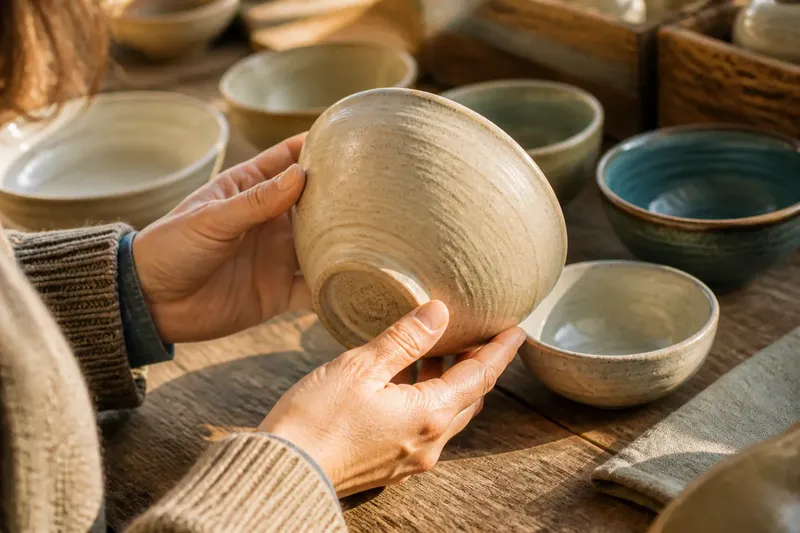
You turn a ceramic bowl over at a craft fair and find a faint ring beneath its foot, plus a tiny seam along the rim. Is it hand-thrown or moulded? Reading the marks on a ceramic bowl is less like spotting a single telltale sign and more like following a trail: each feature offers a clue, but the whole surface matters.
Both methods can produce careful, beautiful work. A potter throws clay on a rotating wheel, shaping it by hand; moulding presses or pours clay into a shaped form. Trimming, glazing, firing and finishing can soften or disguise those differences. When a clue seems contradictory, slow down and inspect another part of the bowl rather than forcing a verdict.
When a circular mark seems to settle the question
Concentric lines on the inside or outside often point to wheel-throwing. As the wheel turns, fingers and tools can leave shallow grooves that travel around the bowl. But a wheel-thrown surface may be smoothed, and a moulded bowl can acquire circular finishing marks after it leaves the mould.
What to try: Look for several related traces rather than one ring. Do the lines vary slightly in spacing or depth? Do they continue around the curve, changing as the bowl narrows? Such variation can fit hand shaping. A perfectly regular circle is not proof of moulding, nor is a ring alone proof of throwing; check the rim, foot and interior for clues that agree.
When the rim looks too even to read
A neat rim is easy to mistake for evidence of a mould. Yet a potter can trim and refine a wheel-thrown lip, while a moulded rim may be altered by hand after release. A glaze that rounds over the edge can hide small irregularities, and a deliberate wobble may be part of the design rather than a production clue.
What to try: View the rim from above, then at eye level. Look for subtle changes in thickness, slight pinching, or a small variation in the curve. Compare those details with the bowl’s overall shape. A hand-shaped rim may feel lively without being rough; an even rim should remain only one observation, not a verdict.
When a seam appears on the body
A narrow ridge or line running down the outside can suggest that two mould sections met. In some moulding processes, clay is pressed into a multipart form, and the join may leave a seam to be smoothed later. But decorative grooves, glaze boundaries, repairs or marks from finishing tools can resemble one.
What to try: Follow the line with your eyes rather than scraping or picking at it. Does it run in a straight, consistent path, or does it wander with the bowl’s contours? Check whether a corresponding line appears on the opposite side. A faint, repeated join can support a moulding interpretation; a lone groove that changes character may have another cause. If the surface is delicate or the bowl is for sale, handle it gently and ask the maker or seller about the process.
When the foot ring gives mixed signals
The base often holds useful evidence, but it can mislead. A trimmed foot ring may show the tool’s path on a thrown bowl. A moulded piece may have a deliberately shaped foot, and either kind can be sanded, glazed or altered during finishing. A rough base can reflect firing supports or later wear rather than the original forming method.
What to try: Turn the bowl only if it can be handled safely, and inspect the foot’s profile and its meeting point with the body. A cut edge, changing thickness and faint turning lines may fit wheel trimming. A repeated, crisp profile or a small mark that resembles a mould’s release point may support moulding. Treat the base as a cluster of clues, not a signature that settles the matter by itself.
When glaze hides the making marks
Glossy glaze can fill shallow grooves; a matte surface can make texture more visible. Glaze pooling near the foot or gathering in a carved line tells you about application and firing, but not necessarily how the clay was formed. A handmade bowl can have a highly controlled glaze, and a moulded one can carry hand-applied decoration.
What to try: Follow the clay beneath the glaze where it remains visible, especially at the foot and any unglazed areas. Tilt the bowl toward soft light to reveal changes in the surface without rubbing it. If the finish obscures the clues, say that the process is uncertain. A careful description is more useful than a confident guess.
How can you tell which making process fits?
Can a single mark prove a bowl was hand-thrown?
No. Circular lines, an uneven rim or a trimmed foot may each be suggestive, but finishing can change them and other methods can create similar traces. Look for several features that make sense together.
Can a moulded bowl have hand-finished details?
Yes. Makers may smooth seams, refine rims, trim feet or add decoration after forming. A moulded bowl can therefore carry marks from both the mould and later handwork.
Does a perfectly symmetrical bowl have to be moulded?
No. A skilled potter can shape a balanced bowl on a wheel, then refine it. Symmetry is a feature to compare with the surface and base, not a reliable answer on its own.
What should you ask a maker or seller?
Ask how the bowl was formed and which visible marks come from forming, finishing or decoration. If the answer is unclear, describe what you can see and leave the method open rather than assigning a process from appearance alone.
When the clues disagree, compare them in sequence
Imagine you find a bowl with even sides, a faint vertical line and irregular grooves inside. You might first check whether the line behaves like a mould seam, then see if the interior grooves vary with the bowl’s curve, and finally inspect the foot for trimming marks. If the seam is clean but the interior and foot show handwork, a moulded body with hand finishing is one possible reading. If the traces remain ambiguous, the useful result is a more precise description, not a forced label.
For a quick inspection, use this order:
- Interior: Look for turning lines, tool marks or a uniformly smooth surface.
- Rim: Compare its thickness and curve at several points.
- Exterior: Trace any seam or ridge and see whether it continues consistently.
- Foot: Notice trimming, sanding and how the base joins the bowl.
- Finish: Check where glaze conceals or emphasizes the clay’s texture.
- Whole form: Ask whether the clues support one another or suggest mixed forming and finishing.
For an everyday bowl, the distinction may matter less than its weight in the hand, stable foot and condition. For a piece whose making process matters to your collection or purchase, ask directly and keep observation separate from certainty. Reading hand-thrown or moulded ceramic bowl marks is most useful when it helps you notice the work beneath the finish—and leaves room for a maker’s answer to complete the picture.